
Best Supplements for Hashimoto's




What I Wish I Knew Before Taking Anything
After being diagnosed with Hashimoto’s, supplements felt incredibly tempting. Every bottle promised more energy, better labs, or faster healing — and when you’re exhausted, that hope is hard to resist.
I went through a lot of trial-and-error, spent money on products that didn’t help, and stacked supplements with high expectations but very little clarity. Some helped, many didn’t, and a few actually made things worse.
This post is meant to be educational, not medical advice. What I wish I had known earlier is that supplements can support healing, but they don’t replace the foundations — food, sleep, stress management, and blood sugar balance still matter most.
The goal here is a grounded, realistic, anti-hype approach so supplements feel supportive, not overwhelming.
Why Supplements Are So Confusing with Hashimoto’s
If you’ve ever searched for “Hashimoto’s supplements,” you’ve probably seen completely conflicting advice. One source recommends a long list of supplements, while another warns against the very same ones. Much of this comes from one-size-fits-all protocols that don’t account for individual needs.
Hashimoto’s is an autoimmune condition, and bioindividuality matters. Nutrient needs vary based on labs, stress levels, digestion, medications, and symptom patterns. Because of this, a supplement that helps one person feel better may actually worsen symptoms for someone else.
That’s why testing matters more than guessing. Supplements don’t exist in a vacuum — timing, dosage, and context all play a role. Without that context, it’s easy to oversupplement or miss what your body truly needs.
Foundational Hashimoto’s Supplements
One of the biggest misconceptions is that everyone with Hashimoto’s needs the same “daily supplements.” In reality, daily support looks different for everyone. Some supplements are baseline for certain people, while others are only helpful when specific symptoms or deficiencies are present. With that said, here are the top supplements that most people with Hashimoto's need to help optimize thyroid health:
Selenium
Selenium is commonly discussed in Hashimoto’s care because it supports thyroid hormone metabolism and helps protect the thyroid from oxidative stress. It may also play a role in reducing thyroid antibody activity for some people. Typical intake is often around 100–200 mcg per day, and going higher isn’t better. Many people can meet their needs through food — 1–2 Brazil nuts may provide enough — while others may use a low-dose supplement. Because excess selenium can worsen symptoms, moderation and context matter.
Vitamin D3+K2
Vitamin D supports immune regulation and helps calm inflammation, which is especially important in autoimmune conditions like Hashimoto’s. Deficiency is very common, particularly in people who get limited sun exposure. General daily intake often ranges from 1,000–2,000 IU, though optimal dosing is best guided by lab results. While sun exposure helps, many people require an over-the-counter supplement to maintain healthy levels.
Iron
Iron is essential for energy production and thyroid hormone transport. Low iron can contribute to fatigue and impair the conversion of T4 to T3. However, iron supplementation should only be used when labs confirm deficiency, as excess iron can be harmful. Some people can improve levels through iron-rich foods like red meat and shellfish, while others may need short-term supplementation under guidance.
Zinc
Zinc supports immune balance, thyroid hormone conversion, and tissue repair. Low zinc levels may contribute to symptoms like hair loss, poor immunity, and low energy. Typical daily intake is often around 15–30 mg, and zinc can be obtained through foods such as meat, shellfish, and seeds. Short-term supplementation may be helpful if intake is low, but long-term high doses should be avoided without proper balance.
Magnesium
Magnesium plays a key role in stress regulation, nervous system support, muscle relaxation, and sleep quality. For people with Hashimoto’s, it can help support recovery and reduce cortisol-driven symptoms. General intake often falls between 200–400 mg per day. While food sources like leafy greens, nuts, and seeds are beneficial, many people find supplements — especially forms like magnesium glycinate — easier to tolerate and more effective.
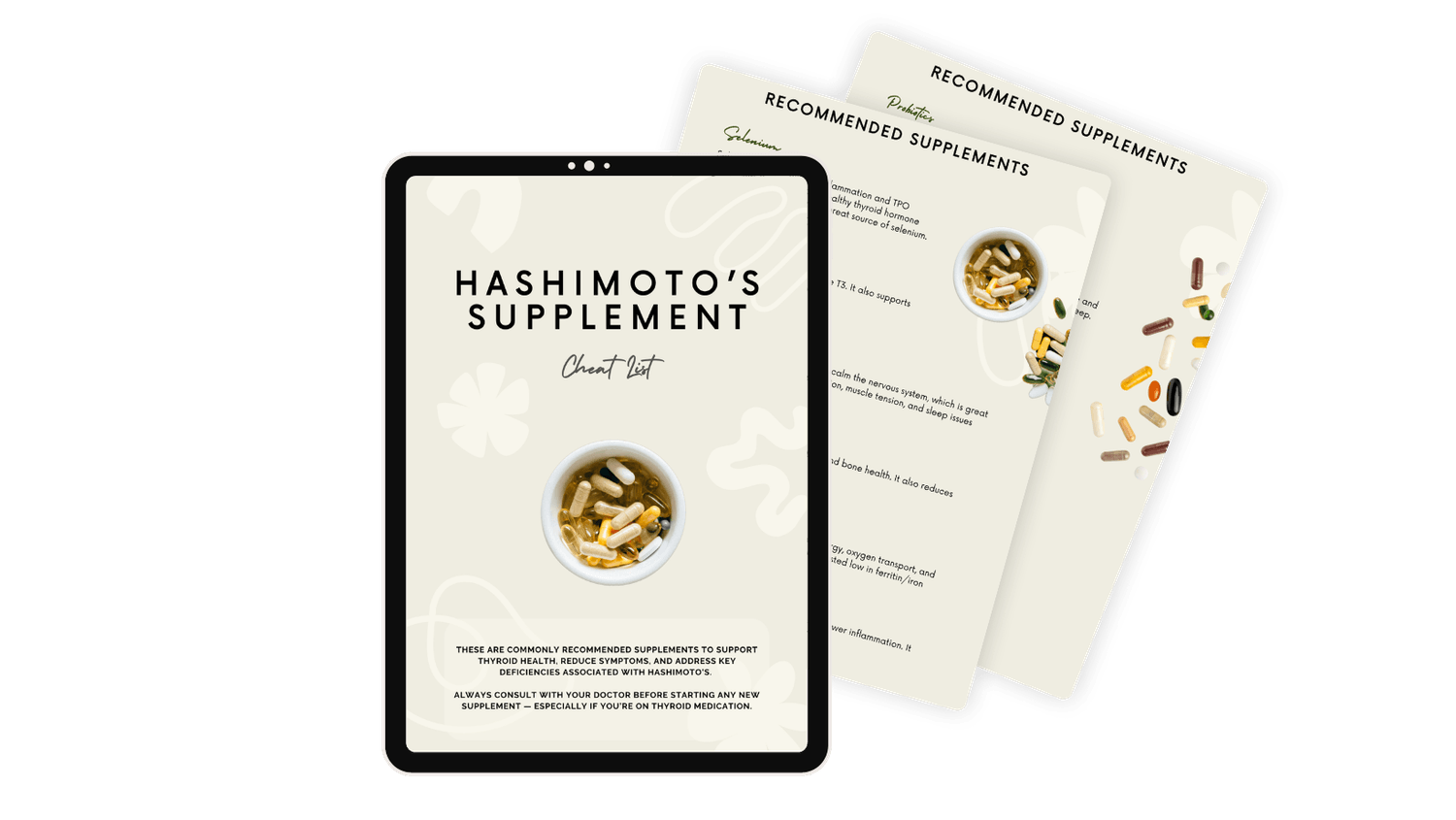
$5 Supplement Cheat List
When it comes to supplements, quality matters just as much as the ingredient itself. Not all brands source nutrients the same way, and poor-quality supplements can be ineffective — or even make symptoms worse. Factors like brand sourcing, third-party testing, and bioavailability determine whether your body can actually absorb and use what you’re taking. Cost also matters, but higher price doesn’t always mean better results — effectiveness comes from quality and formulation, not hype.
If you’re tired of wasting money and guessing, I created the $5 Hashimoto’s Supplement Cheat List to make this simple. Inside, you’ll find trusted, Hashimoto’s-friendly brands, beginner-safe recommendations, and guidance designed specifically for autoimmune thyroid health — so you’re not experimenting blindly.
This is the easiest next step if you want clarity, confidence, and fewer supplements cluttering your cabinet.
👉 Get the $5 Hashimoto’s Supplement Cheat List
Final Thoughts: Supplements Should Support You, Not Stress You Out
Supplements are meant to support your healing, not become another source of stress or pressure. You don’t need to take everything at once, and you don’t need to rush the process. With Hashimoto’s, slowing down is often part of healing.
Less is often more. A few well-chosen, intentional supplements — used with context — are far more helpful than chasing every new recommendation. Informed, thoughtful choices will always serve you better than trying to “fix” everything quickly.
Latest Posts
JOIN MY NEWSLETTER
Get wellness tips, exclusive offers, & recipes directly to your inbox regularly
© 2025-2026 All Rights Reserved
Content on this website is not considered medical advice.
Please see a physician before making any medical or lifestyle changes.
© 2025-2026 All Rights Reserved
Content on this website is not considered medical advice.
Please see a physician before making any medical or lifestyle changes.